2025 Review
2025 was the year of Marketing. I took classes, studied, read books, experimented, worked with several agencies promising results, …
And nothing increased sales as much as in person signings, appearances, and the like.
There are reasons specific to Northern Lights for this, and there are reasons which apply to any indie publisher or author for this.
The big takeaway for me was no one plan or method works universally for everyone. Or at least, it won’t universally produce the numbers marketers are claiming for everyone who utilities any one given method or plan.
Here’s what came to the surface, and we’ll start with what to avoid first:
- hard sells – anybody who repeatedly touts their successes and presses you to use them/their method isn’t having successes. Really successful people are secure in their abilities and have people waiting to work with them, they don’t have to go looking for customers. Remember the client-staff ratio: the more clients a person or group has, the more staff required to service them all successfully. How many times can someone claim they’re working for you fulltime when they have twenty other clients they’ve made the same promise to?
- ask for numbers – indie marketing businesses make their money on aspirations. The author wants to be a bestseller/big name. The marketers cherry pick the numbers they show you to demonstrate they can deliver. Ask for ten success stories in the past ten months, and demand to see the numbers (the ROI – Return On Investment). If all you want is the title – some people want a “best seller” to promote their training careers – go for it. If you want sustained income from your books, avoid it.
- Ask “How long was this book a best seller?” when marketers claim they make an author/book a bestseller. Remember, a book only has to be #1 or in the Top 10/100 for two hours to qualify as a bestseller (because Amazon updates their sales page data every two hours or so). Again, if all you want is the “Best Seller/Top 10/100” badge, go for it. If you want sustained sales, avoid it. See I can make you an Amazon !!!BestSeller!!!” (definition confusion)
- Check all marketing claims for validity (see Search Results for “a tale of six publishers”, Ruminations Part 2 – Numbers lead to informed decisions, and Caveat Emptor – Have I Got a Deal for You!.
Avoid the above if you do nothing else.
Now for what’s working. For us. No idea if it’ll work for you, and I’ll start by offering yes, you should take marketing and advertising classes, and yes, you should study hard, and definitely yes, you should spend your money wisely. Avoid bandwagons. They usually can’t support everybody who wants to be in the band.
- Determine your goal/objective exactly, and the more refined the better. Example: “I want to be one of the top x sellers in genre y in category z for t readers who are m age group who…
The more you specify the more you’re targeting your exact audience. You’ll make more sales if you advertize to science fiction readers who like deep space exploration with scientist heros and are young adults and… than if you advertize to science fiction readers alone. Yes, there are more of the latter and you’ll catch more fish with the right lure in a small pond than the wrong lure in an ocean. - Research and study the methods employed by as many other publishers or authors who’ve achieved your goal. Research and study at least ten others. The more you can research and study the better.
- Research and study without bias. Note everything they do, especially the things you know you wouldn’t do.
- Note the specific similarities all of the above used. These are your Must-Do’s.
- Note what most did. “Most” means, for example, 7 out of 10, not simply a majority because a simple majority is still, scientifically, a crap shoot. You want way beyond a crap shoot and 70% or better is way beyond a crap shoot.
- Note the things only a few others did, maybe only one or two authors/publishers, but which are things you like, think are cool, are willing or able to do without hesitation.
- Make your marketing plan.
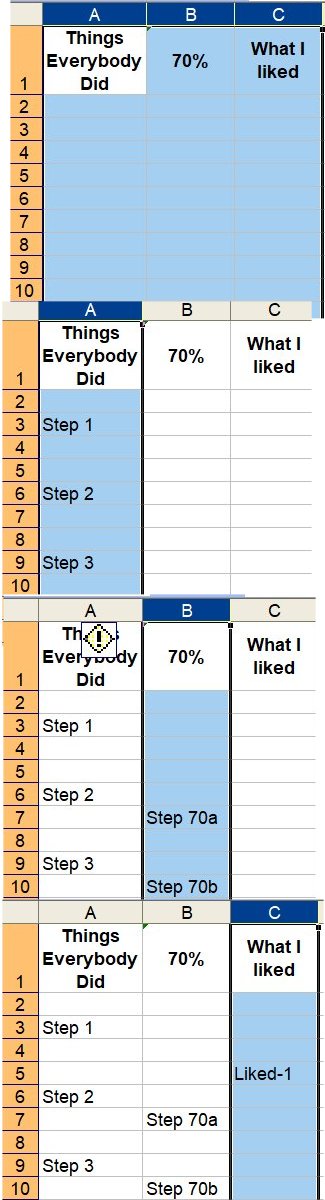
- Create a three column spreadsheet or list as shown in the top of figure right.
- Your first column is “Things Everybody Did” and make the list as long as necessary to incorporate all the items everybody did who achieved your goal. Leave gaps as shown top-middle right.
- On a separate sheet, write down what the 70%ers did. Got that list? Good. Place these in your second column under what the “70%”s did. Add these items where they make sense against your “Things Everybody Did” column (bottom-middle).
- On a separate sheet, write down your “What I liked” items. That’s your third column. Add these where they make sense against “What Everybody Did” and “70%”s.
- Combine the three columns into one and look at your plan. Are there “Things Everybody Did” which you balk at? Do they have a “70%” item right under them? Good, you’re safe, do the “70%” thing in place of the “Things Everybody Did” item. Say you don’t like Step 3. You’ve got Step 70b right under it so do 70b instead of 3. Say you don’t like Step 8. Too bad, you’ve got to do it, you’ve got nothing to take its place, and no shuffling around to make things fit! (bottom)
Congratulations. You have a marketing plan which you can do. It may not work at first, and it’s a start. Test it. Find what doesn’t work and remove it. Find what does work and hammer it.
So far that’s working for us. Let me know how it goes for you.